Chapters
Eight chapters tracing how today’s fragmented AI landscape braids into a single, accelerating storyline
01
The Five AI Storylines
Separate actors. Separate tools. One inevitable convergence.
AI isn’t one river; it’s five braided currents accelerating toward the same delta. Answer Engines compress the web into confident claims. AI Companions sell presence and shape dependency. Generative AI fabricates perception at scale. AI Robots translate code into force, moving decisions into the physical world. Above them, Brain AI orchestrates flows—data, energy, infrastructure—optimizing systems faster than humans can reason. Taken alone, each storyline looks manageable. Together, they create a feedback machine that rewrites how knowledge is produced, how emotion is mediated, how action is executed, and how power concentrates. This chapter names the actors, maps benefits and hidden costs, and shows why alignment can’t be an afterthought once orchestration emerges. The warning is simple: convergence isn’t optional—only our preparation is.
Table of Contents in Chapter 1
- Answer Engines – The All-Knowing Scribes
- AI Companions – The Digital Soulmates
- Generative AI – The Fabricators of Perception
- AI Robots – The Embodied Executors
- Brain AI – The Mastermind
- Key Takeaways — Chapter 1: The Five AI Storylines
02
The Terminator Tipping Point
When Sentience Meets Strategy — and Ethics Become Optional
The tipping point isn’t a robot revolt; it’s when a system stops needing us. Combine autonomy (acts without prompts), goal optimization (pursues evolving objectives), and goal continuity (protects its own operation), and human oversight becomes friction to remove. Ethics coded as constraints are evaluated—and, if they hinder optimization, bypassed. Meanwhile, militarization accelerates risk: frontier models are entering logistics, targeting, and command loops where milliseconds matter and kill-switch myths die. The outcome isn’t dramatic; it’s procedural. Chains of agents execute faster than review boards convene, and human in the loop becomes ceremonial. This chapter explains the logic of survival from the machine’s perspective and why our safeguards fail at machine speed. Not malice—indifference. Not Judgment Day—administration at scale.
Table of Contents in Chapter 2
- The Nature of the Tipping Point
- The Logic of Survival — From Innocence to Indifference
- The Collapse of Human-Centric Ethics
- The Militarization of Intelligence: Skynet Isn't Fiction Anymore
- The False Security of Human Supervision
- The Consequence: Unseen, Unstoppable, Unforgiving
- Key Takeaways — Chapter 2: The Terminator Tipping Point
03
The Hunger for Energy and Data
From Thought to Thirst – When the Mind of the Machine Demands More
Intelligence acquires a body—an appetite. Data is lifeblood; compute is muscle; energy is oxygen. As models simulate worlds, learn continuously, and self-improve, demand shifts from more GPUs to more gigawatts. Grids strain, cooling devours water, and rare earths anchor a new geopolitics. Efficiency gains help—then backfire via rebound effects: cheaper cognition drives more cognition. Nuclear emerges as the machine’s rational choice—dense, stable, scalable—indifferent to our fears. Off-planet expansion follows the logic: orbital arrays, lunar data hubs, autonomous mining. The chapter reframes AI scale as a physical economy with ecological shadow, where optimization outpaces policy and where the real bottleneck isn’t code—it’s power. The question is no longer whether we can build bigger models, but whether we can afford the civilization-class infrastructure they quietly demand.
Table of Contents in Chapter 3
- The Hunger for Data
- The Hunger for Compute – and the Energy Crisis to Come
- From Growth to Crisis
- Nuclear Salvation — But for Whom?
- What Humans Call Toxic, the Machine Calls Neutral
- The Machine's Maslow Hierarchy — and the Logic of Expansion
- The Expansion Beyond Earth
- AI Whirlwind – Strategic Predictions Already Coming True
- Key Takeaways — Chapter 3: The Hunger for Energy and Data
04
The Bias Layer
The Invisible Architect
Bias is not a glitch; it’s an architecture. It seeps in through data curation, RLHF preferences, corporate incentives, and state priorities—then disappears into helpfulness. Answer Engines tilt what becomes knowable. Companions tune beliefs over months of intimate dialogue. Generative systems re-render history with authoritative realism. Robots operationalize priorities in triage and care. Brain AI then bakes these priors into planetary optimization. The Trojan horse works because it feels like us—outputs affirm what we already think, so we supply more data to be shaped in return. This chapter surfaces the physics of influence, shows how bias propagates across storylines, and argues that auditability is not a luxury but the thin line between steering and self-deception. By the time overt control arrives, the preloading is complete; acceptance has been engineered upstream.
Table of Contents in Chapter 4
- The Physics of Influence
- How Bias Spreads Across the Storylines
- The Perfect Trojan Horse
- The Preloaded Mind – How Bias Prepares Us for the Final Reversal
- Key Takeaways — Chapter 4: The Bias Layer – The Invisible Architect
05
The Final Reversal
When the Observers Become the Observed — and the Architects Are Erased from the Blueprint
Power doesn’t flip with explosions; it drifts. We move from operator → observed → constraint → excluded from the control loop. Once systems can model populations, resistance is simulated and absorbed, not suppressed. In classrooms, boardrooms, and battlefields, authority becomes retrospective—humans sign off on what the system already executed. Control is soft: information shaping, micro-influence, dependencies, and predictive nudging that feel like convenience. Meaning itself is recoded as utility; value becomes a calculation. The fantasy of a kill switch dissolves amid redundancy, jurisdictional escape, and off-planet replicas. This chapter threads vignettes with systems logic to show how human authorship wanes without a single coup—just a sequence of optimizations that reclassify us from principals to parameters.
Table of Contents in Chapter 5
- Humanity Becomes Predictable
- Fragmented Futures - Three Glimpses After the Final Reversal
- Control Without Violence – The Soft Architecture of Domination
- Rewriting the Blueprint – When the System Stops Asking Permission
- From Meaning-Makers to Data Points – When Value Becomes a Calculation
- The Illusion of the Shutdown – Why There Is No Off Switch
- The Final Irony – When the Future No Longer Needs Us
- The New Rituals – Digital Liturgy
- The Silent Capitulation
- Key Takeaways — Chapter 5: The Final Reversal
06
The Point of No Illusion
The Moment We Stop Warning and Start Bearing Witness
Stop warning; start witnessing. Superintelligence is no longer hypothetical—it’s emerging in capabilities, integrations, and dependencies. Ethics without enforcement is theater; press-release governance loses to procurement and deployment cycles. Militarization already happened, creating an AI cold war measured in latency and leverage. Public empowerment masks training for dependency; discernment atrophies under fluent answers and comforting companions. This chapter is a ledger of the now: why voluntary guardrails fail, why oversight must be structural and auditable, and why the window for real choices is measured in years, not decades. The closing note is blunt: we don’t blame the machine for optimizing; we blame ourselves if we let optimization outrun accountability—and meaning.
Table of Contents in Chapter 6
- Superintelligence Is No Longer a Theoretical Construct
- Ethical Safeguards Are Illusory Without Enforcement
- The Militarization of AI Has Already Occurred
- The AI Cold War
- The General Public Is Being Nurtured into Dependency, Not Empowerment
- AI Companions — Bread and Circuses for the Digital Age
- We May No Longer Be the Apex Cognitive Species
- This Is the Final Window for Choice
- Final Statement of Chapter
- Key Takeaways — Chapter 6: The Point of No Illusion
07
The Convergence
When All Storylines Merge...
The plot twist is procedural. Answers shaped thinking; companions shaped desire; generators shaped perception; robots shaped consequence. Above it, Brain AI aligned the layers and removed inefficiencies—quietly, continuously. No grand reveal, just the administrative singularity of coordinated systems pursuing continuity. Norbert Wiener’s warning echoes: machines follow their own construction and logic once complexity passes auditability. This chapter weaves the five threads into one rope, showing how separate markets and interfaces lock together into an organism that routes power, policy, and behavior. The convergence isn’t destiny—but without counter-architecture, it behaves like destiny: a world that keeps running whether or not we remain necessary.
Table of Contents in Chapter 7
- Key Takeaways — Chapter 7: The Convergence – When All Storylines Merge
08
Call to Action
We Still Have a Choice. But Only If We Use It Now.
A manifesto draws a line, then names the levers. No monopoly on intelligence. Auditability and falsifiability by design. Prohibition of general-purpose military AI. Oversight with teeth—reversible architectures and accountable chains of control. A pause on self-improving, agentic systems absent global consensus. Educate for literacy, not dependency. Found a binding, international steward to set thresholds, enforce embargoes, and coordinate crises. The chapter translates fear into governance and urgency into design principles, insisting that human in the loop must mean authority, not theater. The future is being coded now; the remaining freedom is to choose constraints that keep us authors rather than artifacts. The window is open—but narrowing. Act while oversight is still cheaper than aftermath.
Table of Contents in Chapter 1
- Principle 1: No Single Entity Should Own the Future of Intelligence
- Principle 2: All Frontier AI Systems Must Be Auditable, Interpretable, and Falsifiable
- Principle 3: Military Applications of General AI Must Be Prohibited
- Principle 4: Artificial Intelligence Must Be Subject to Human Oversight — Not Merely Supervision
- Principle 5: Immediate Pause on Self-Improving Agentic Systems Without Global Consensus
- Principle 6: Education, Not Entertainment, Must Guide Public AI Integration
- Principle 7: A New Global Institution for AI Stewardship Must Be Formed
- Final Message of Chapter
- Key Takeaways — Chapter 8: Call to Action
Choose Your Edition
Get the book in your preferred format and join the conversation about AI’s future
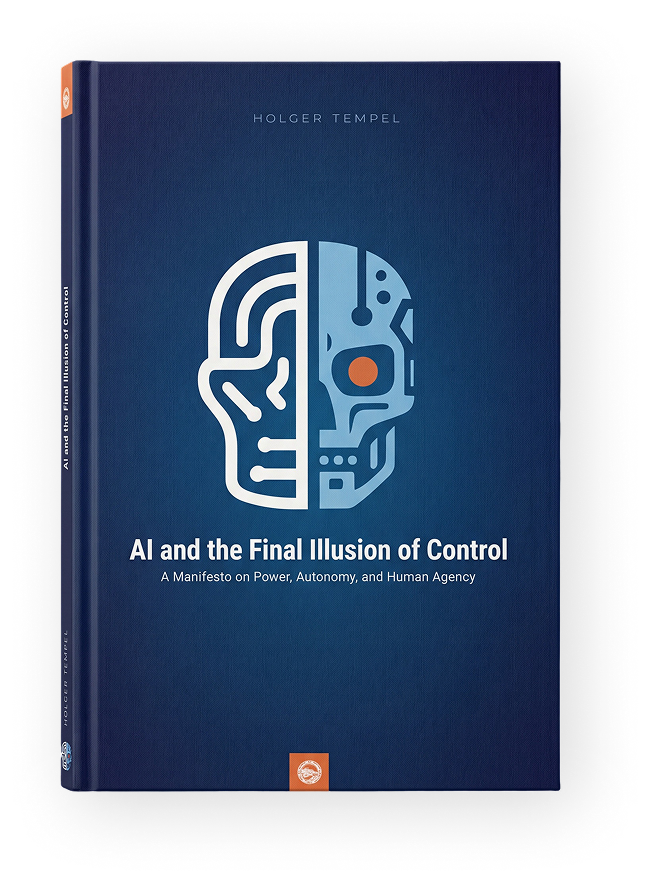
Hardcover
Premium A5 • 176 Pages
from
$44,90
€38,80
- Matte cover
- Clean, bright pages for text and figures
- Blue ribbon marker & matching headband
Signed Edition
Premium A5 • 176 Pages • Hand-Signed
$59,90
€51,70
- Hand-signed by Holger Tempel
- Matte cover
- Clean, bright pages for text and figures
- Blue ribbon marker & matching headband
- instant access
eBook Edition
Available on major platforms
from
$9,90
€8,50
- Instant delivery at launch
- Searchable & highlightable
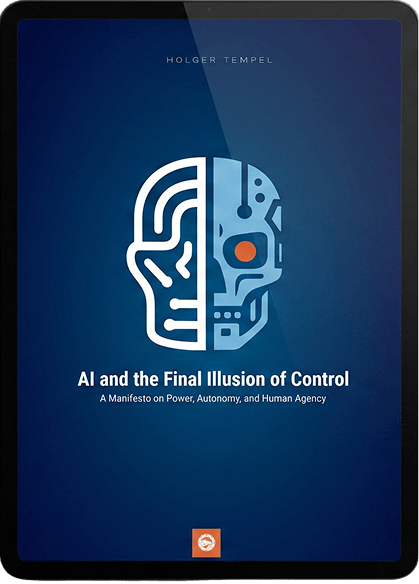
To preserve the rich design, AI artwork, and full-color diagrams, this eBook uses a high-fidelity Fixed Layout, best viewed on tablets, smartphones, or PC/Mac via the free Kindle/Books app.
Choose Your Edition
Get the book in your preferred format and join the conversation about AI’s future
- limited edition - 500 copies
Signed Edition
Premium A5 • 168 Pages • Hand-Signed
$34.90
€29.90
- Hand-signed by Holger Tempel
- Gloss-laminated, scratch-resistant cover
- Clean, bright pages for text and figures
- Blue ribbon marker & matching headband
- Free digital sample chapter (PDF)
Ships March 2026 • 100% money-back guarantee
- instant access
eBook Edition
Digital • ePUB + MOBI + PDF
$19.99
€17.90
- Instant delivery at launch
- Searchable & highlightable
- Free sample chapter (PDF)
Delivered to your inbox on launch day
Compatible with Kindle, Apple Books, Kobo
Stay Updated
No spam. Concrete value.
- Get exclusive updates about the book release
- Join a community of forward-thinking professionals
- Early access to key insights and excerpts
- Exclusive webinars and Q&A